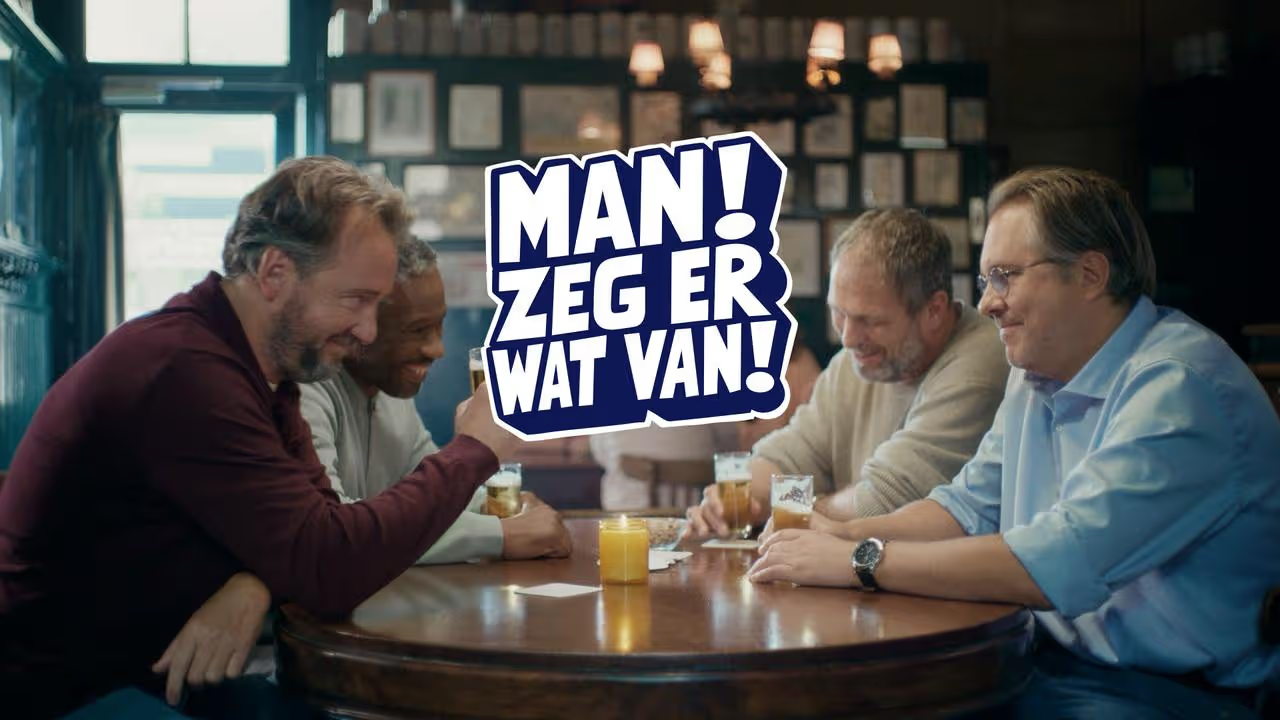
In November 2025, the Dutch Central Government launched a campaign called ‘Say something, man!’ (Man, zeg er wat van!), aimed at inspiring people to call out sexually inappropriate behaviour. The campaign specifically targets men, prompting them to call out their friends, coworkers and peers when they make boundary-crossing remarks.
In one of the ads, four middle-aged men are sitting in a café, being served by a young woman. When one of the ‘lads’ verbally sexually harasses the woman, one of them has an internal dialogue: ‘That’s a really messed-up joke.’ But another voice in his head tries to justify his friend’s behaviour: ‘What do you mean? We always talk like that.’ In the end, he realizes that the comment was not okay and decides to speak up against his friend: ‘Dude, what if that was your daughter?’. Because of this realization, his friend understands that maybe it wasn’t such a hilarious joke after all. Rather than offering a sincere apology to the woman, however, the situation is resolved with a light-hearted joke about the harasser paying the bill. The tension dissolves. The men laugh. End good, all good.
Or is it?
This campaign is well-intentioned: it addresses men directly, encourages peer accountability, and makes bystander intervention visible. However, it falls into a common pattern seen in efforts to mobilize men as active bystanders. In seeking to trigger empathy and compassion for victims of harassment, it relies on the familiar ‘this could be your daughter, sister, or friend’ trope: a widely used strategy in similar campaigns.
It asks men to imagine how they would feel if such remarks were directed at someone close to them. While it seems like a good idea to frame empathy as a tool to evoke reaction and to trigger men to stand up, the message here seems that women deserve empathy, but only when they are in some way related to men. This framing subtly suggests that women’s dignity becomes legible only through their relationship to men. In doing so, the campaign risks reinforcing the very gender hierarchies it seeks to challenge. Instead of recognizing women as autonomous individuals deserving of respect in their own right, it invites men to imagine ownership, proximity, or protection as the moral trigger. In this sense, the message of the campaign centralizes men when it should centralize the experience of women.
Moreover, the situation does not lead to a meaningful conversation about the impact of such behaviour. Instead, it is resolved through humour. The victimized woman does not gain anything from this, not even an apology. Another note should be made about the language in which the ads of this campaign are expressed. In an effort to sound relatable, the advertisements use very vulgar, misogynistic language as examples of sexually inappropriate or boundary-crossing comments. This does nothing to help the root cause of this problem, but simply gives a platform to such language, even with the risk of reproducing it.
At Fairspace, we teach people the 5D’s of being an active bystander: Distract, Delegate, Document, Delay and Direct. The advertisement clearly models one of these strategies: Direct. One of the men speaks up and names the remark as inappropriate. Direct intervention is powerful. But what motivates that intervention shapes the message we send about who deserves respect: by using the ‘this could be your daughter’ narrative, respect becomes conditional. Women’s safety becomes something men grant to those they recognize as belonging to them.
Ultimately, this advertisement was meant in a positive way, but risks reproducing the structures of misogyny it seeks to challenge. Women should not have to be someone’s daughter, sister, partner or mother to be respected and to be valued. They deserve dignity simply because they are people.
Hannah Lakke is a Master’s student in Gender Studies at Utrecht University and is doing an Internship at Fairspace as a Training Coordinator. With a background in Sociology and Youth, Society & Policy, she is interested in gender, power, and social inequality, particularly in relation to sexual boundary violations and bystander intervention.